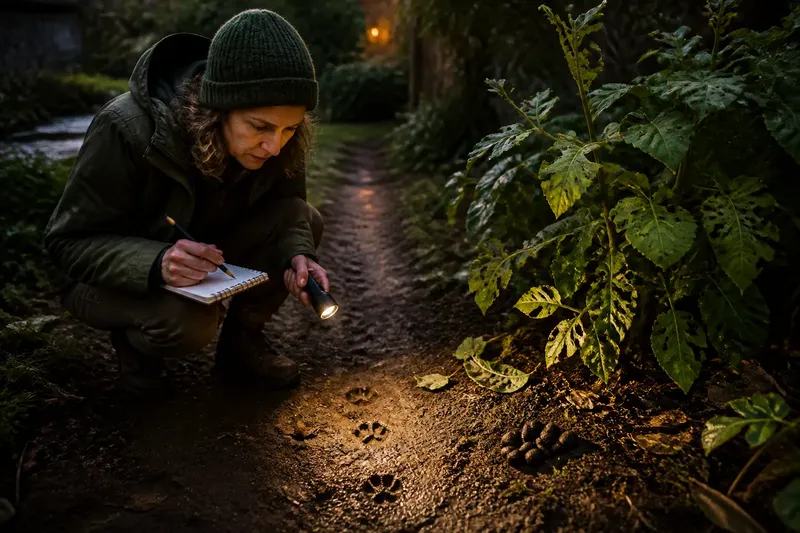
A Pocket Field Note for a Familiar Walk
Pocket field notes help you capture a plant or animal’s position and behaviour clearly, so you can draw it, identify it later and protect its habitat.
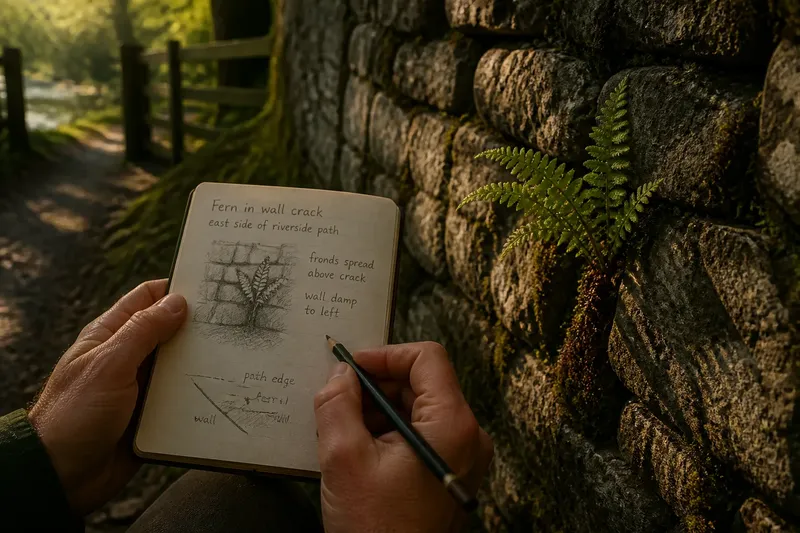
A pocket field note is clearest when it captures one moment, not the whole walk. On a familiar path, choose a safe view of a plant, animal or habitat feature, then record what is visible and where it sits. A pencil and folded notebook are enough.
Choose a useful view
Look for a feature with a distinct outline or position: a leaf emerging from a wall crack, a bird pausing on a fence, or a line of damp soil beside a path. Stand where you can see it without stepping off the path, touching it or blocking its route.
Before writing, decide what your note should help you recall: the shape of a leaf, the direction an animal moved, or the boundary between wet and dry ground. This gives the sketch a job and keeps the entry focused on a detail that may be hard to describe later.
Build a spatial sketch
Draw the subject as a simple shape, then add two nearby landmarks, such as a path edge and a gatepost. Use a dot or arrow to mark the subject’s position or direction of movement. Label only details that might otherwise be mistaken for something else.
For a plant, show how leaves attach to the stem or where it meets a wall. For a moving animal, draw its last clear position and add an arrow; do not follow it into cover. A rough diagram that preserves these relationships is more useful than careful shading.
Use a compact notation
Keep a small set of marks consistent. For example, use an arrow for movement, a question mark for an uncertain feature and a short line for the edge of shade. Write the meaning beside the first sketch if you might forget it.
- If you can see a plant’s leaf arrangement, draw the leaves on the stem; if leaves are hidden, leave that detail blank rather than infer it.
- If an animal makes a sound you can distinguish, write a plain description such as “two short chirps”; if you cannot hear it clearly, omit the sound.
- If the subject’s position is clear against a landmark, mark both on the sketch; if the view is obstructed, note the obstruction instead of guessing its location.
- If light or shadow changes the subject’s outline, mark the shade boundary; if it does not affect the feature you are drawing, leave it out.
- If a feature looks unusual but is uncertain, add a question mark and a brief description; if it is clear, record it without adding an identification you cannot support.
- If a moving subject leaves your view, mark its last visible direction; if the direction is unclear, record only the last position.
Keep the drawing safe
Use a pocket notebook, a blunt pencil and a firm backing such as a small card if the paper folds easily. Keep the notebook in hand rather than placing it on vegetation, and do not lean over a nest, den or fragile patch to improve the view.
Leave precise location details out of any note you plan to share if they could lead someone to a vulnerable species. A broad place-name can help you remember the setting without pointing others directly to it.
What makes a field sketch useful?
How much detail should I draw?
Include the subject’s outline and the nearby feature that fixes its position, then add only details that answer your question. If the purpose is to remember a plant’s shape, the path and weather need not dominate the page.
What if I cannot identify the subject?
Draw and describe what you can see, such as “small bird, pale stripe above eye”. Leave the name open; an uncertain label can make a later comparison less reliable.
Should I sketch a photograph instead?
A phone photograph can preserve colour and fine texture, but it may not show movement or the subject’s place in its surroundings. If you take a picture, add a quick arrow or note for the detail the frame does not explain.
What if the subject moves?
Mark its last clear position and add the direction it travelled if you saw it. If it disappears behind cover, stop there rather than approaching or disturbing it.
Work through one entry
Say you stop on a public path beside a low stone wall and notice a small fern growing from a crack. You have a folded notebook, a pencil and a clear view from the path; these are invented details for the example.
- Write “Fern in wall crack” and a broad location such as “east side of the riverside path”.
- Draw the wall edge as a horizontal line, mark the crack with a short vertical line and sketch the fern emerging from it.
- Add three visible fronds and a small patch of shade, but do not guess the species or draw roots hidden inside the wall.
- Write “fronds spread above crack; wall damp to left” only if those features are visible from your position.
- Check the result against the purpose: the sketch shows where the fern grows and the direction its fronds spread. If the crack is not clear in the drawing, add a label; if it is clear, leave the sketch uncluttered.
The finished entry answers a practical question: what grew where, and what could be seen about its form? It does not claim to identify the fern or explain why it is there.
Make a field note easy to use
Leave room beside the sketch for one later annotation, such as a corrected identification or a note that a detail was obscured. Keep that addition separate from the original drawing so you can tell what you saw at the time from what you learned afterwards.
A pocket field note works best when its marks are legible and its location is safe to record. Before closing the notebook, check that the subject, its position and the meaning of any arrows are clear; that small pause makes the sketch useful without adding unnecessary detail.